Panic disorder
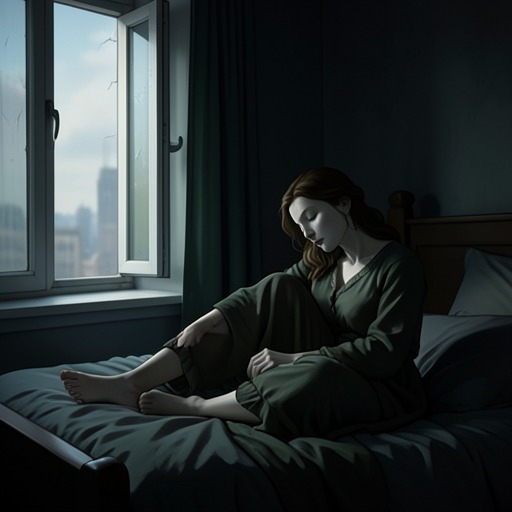
The Woman in the WindowPanic disorder is a condition Anna Fox identifies in describing her psychiatric history, not a diagnosis the novel explains through a clinical symptom inventory. Its clearest appearances are acute: after Anna is found unconscious in a park and taken to Morningside Hospital, she has a panic attack on regaining consciousness and another the following morning. The episodes bring her history into the open, but the story does not reduce her subsequent uncertainty about what she has seen to panic alone.
Recognition at Morningside Hospital
The hospital doctor tells Anna that emergency medical technicians could not identify her after finding her unconscious in a park, so they brought her to Morningside Hospital. When she came around, she had a panic attack; the nurse emphasizes its severity, and the doctor confirms that another occurred that morning. The repeated episodes prompt the doctor to ask whether Anna has a history of panic attacks and whether she is a doctor herself.
Anna first answers with the name Dr. Julian Fielding, then catches herself and says it is not him. When the doctor asks about her background, Anna clarifies that she is not a medical doctor. In this exchange, the urgent question of what happened to the woman Anna says was stabbed competes with the staff’s effort to understand Anna’s condition and assess her account.
History, treatment, and confinement
In response to the doctor’s questions, Anna describes her agoraphobia, depression, and panic disorder together. She also recounts her drug regimen, nearly ten months indoors, and treatment with Dr. Julian Fielding, including his aversion therapy. Her account takes time: her voice still feels muffled to her, and she drinks water as she works through the explanation. The doctor listens, consults her clipboard, and then asks Detective Little to speak with her outside the room.
The scene establishes panic disorder as one element in a broader history that includes severe restriction of Anna’s movement and ongoing treatment. It does not specify the drugs, provide a detailed account of the attacks’ symptoms, or establish that panic disorder caused her confinement. Instead, the condition becomes part of the information she must give hospital staff while insisting that her report of a stabbing also be taken seriously.
Reconstructing what happened
Later, Anna’s recollections and interpretations become increasingly uncertain, but the narrative does not identify each uncertainty as a symptom of panic disorder. She pictures herself dragging her body from the stoop and hauling herself up the front steps, while acknowledging that she can almost remember doing so. Another mental reconstruction brings together bottles, pill canisters, chess pieces, and her ink-stained hand holding a pen. She recalls practicing Jane Russell’s name on a steamed shower door, where the letters ran down the glass and disappeared.
These images show Anna testing the provenance of her own memories: what she experienced, what she may have imagined, and what she has inferred. Her account of the night she witnessed a stabbing also turns cinematic in her mind, invoking Rear Window, Body Double, and Blow-Up. The association supplies a framework for understanding her habit of watching through windows, but it does not, by itself, prove that the event was unreal or that panic disorder produced the perception.
Perception and the limits of diagnosis
Anna later mentally rewinds the sequence of people who have visited her and returns to the first conversation with the woman she knew as Jane. She recognizes that the woman did not necessarily introduce herself as Jane Russell; Anna may have supplied that identity after hearing her say she was headed next door. This is a specific correction in Anna’s account of how her belief formed, rather than a general conclusion that her observations are false.
A photograph complicates the uncertainty further. In a sunset image Anna took from the kitchen window, the woman she knew as Jane appears reflected in the glass. The image carries a timestamp of 6:04 p.m. and a date almost two weeks earlier. Set against Anna’s hospital history and her own questioning of memory, the photograph preserves the novel’s central tension: a psychiatric history can make her testimony vulnerable to doubt, while concrete details may still support what she claims to have seen.